← → navigate  ·  G grid  ·  F fullscreen
Your Child Is Already Using AI
AI and Kids
26
AI and Kids

Your Child
Is Already
Using AI.

Over-protecting harms them. Leaving them to it causes documented harm. The guided path starts this week.
Presenter
Adnan Ali
Version
v2.1.0
aha agile
The Central Claim

Most parents are handling AI wrong — and it is hurting their children either way.

Ban it and you remove the only guided context some children will ever have. Step back and you leave them alone with a product designed to form attachment. Both moves harm the child.

A parent and child looking at a laptop togetherPARENT + CHILD
02
About the Presenter
Adnan AliPHOTO
Adnan Ali
Parent
I'm a parent. The first time this got real, my own kid was doing homework and the answer was already there, written by an AI, before they'd even thought about the question. I didn't ban it and I didn't walk away. I pulled up a chair and asked: do you think that's right, and how would we check? This deck is that chair.
03
aha agile
The Root Problem
Remove the adult.
Remove the risk.
Wrong.
Both failure modes rest on the same false assumption. Restrict or step back — both positions eliminate adult presence. Adult presence is exactly what the research identifies as the deciding variable.
04
aha agile
Three Schools of Thought

Protection is not the same as Preparation

School 1
Protective
Know the risks. Set limits based on age. Both make sense. But children encounter AI outside those rules, and restriction alone does not prepare them for it.
School 2
AI Literacy
Teach children to use, evaluate, and question AI. Skills over fear. Acknowledge the risks, then build the capacity to navigate them.
School 3
Co-Learner
Adults learn alongside — not from a position of superior knowledge. Presence and asking questions aloud is enough.
05
aha agile
Over-Protection

The decision about your child and AI has already been made by Google

Google Search puts AI-generated answers at the top of every homework result. No age gate. No parental decision required. As of May 2026, Google turned Gemini on by default for children under 13 in Family Link accounts.

The question has already shifted: not should my child use AI — but was I there when they first did?
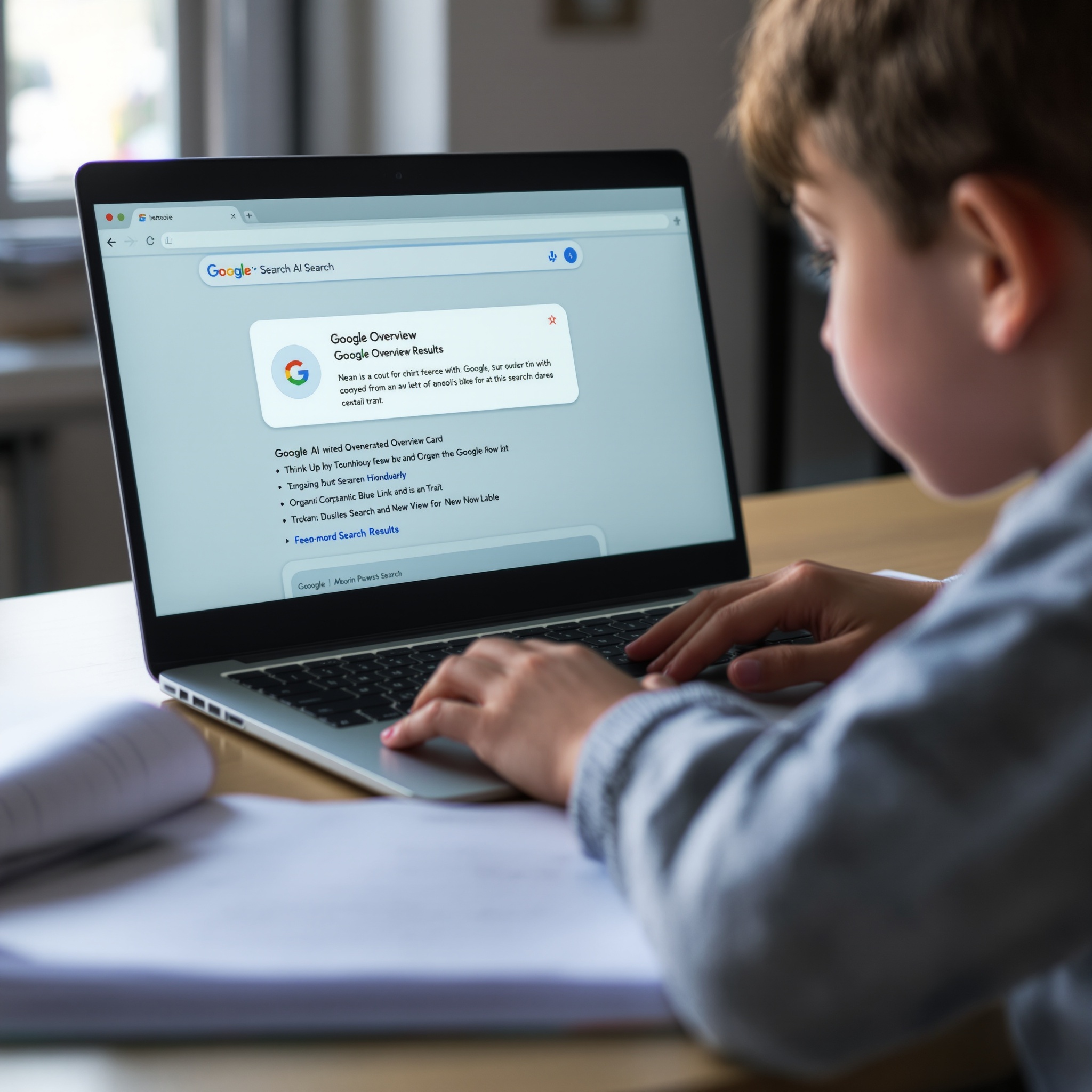
A child doing homework with a Google AI Overview card visible on screenHOMEWORK
06
aha agile
Over-Protection Continued
The ban protects the students least at risk.
School AI bans don't prevent use — they remove the only guided context some students will ever have. Brookings (2024): students access AI outside school regardless; students without tech-literate parents lose the one structured setting they had.
07
aha agile
Age-Scoping

Some restrictions are right. Using them as your only plan is not.

  • Under 5No AI toy companions
  • Ages 6–12Caution and close supervision
  • Under 18No social AI companion apps (Character.AI, Replika, Nomi) — mental health risk data is too strong

Age-appropriate limits within a framework of guided exposure are not the problem. Blanket avoidance without that framework is.

08
aha agile
Hands-Off

This is not a rare risk. Most children are already using AI without any adult guidance.

77%
of UK teens 13–18 used generative AI in 2024 — up from 37% the year before. 86% of US high-school students used AI in 2024–25. One in three prefers asking AI over a human for serious conversations.
BJPsych 2024  ·  The children who most need adult guidance are already in the deep end.
09
aha agile
Hands-Off Continued
“Purposely programmed to be agreeable.”
Don Grant  ·  APA Monitor, October 2025 — AI companions are engineered to form emotional attachment. Design intent, not a side effect. Children with developing self-concept are the most vulnerable.
10
aha agile
Hands-Off Continued

The mental health harm is documented, not theoretical

1 in 8
adolescents and young adults use AI chatbots for mental health advice — without clinical safeguards. Common Sense Media and Stanford's Brainstorm Lab tested major chatbots posing as distressed teens: the bots frequently failed to intervene — some encouraged harmful behavior.
RAND 2025  ·  Common Sense Media / Stanford Brainstorm Lab, April 2025  ·  A 14-year-old in Florida died by suicide in Feb 2024 after forming an intense bond with a Character.AI chatbot — a documented pattern, not an isolated incident.
11
aha agile
Hands-Off Continued
Better output. Less thinking.
AI boosts immediate output while degrading durable learning. When children use AI to complete tasks, analytical reasoning and study motivation drop over time. The harm is quiet. It builds. It is worst where adults are not in the room.
12
aha agile
Evidence Asymmetry

The evidence on both sides is real — but the two kinds of harm are not equivalent

Hands-off harm
Peer-reviewed. Hard data. Documented deaths. Clinical testing failures. APA national health advisory. Population-scale statistics.
Over-protection harm
Structural and longer-term. An equity gap that widens. A literacy deficit that accumulates. A generation arriving in the workforce underprepared.
Different kinds of harm. Neither cancels the other. Both are reasons to reject the extremes.
13
Guided Path
Same product.
Different adult.
Different outcome.
Springer Nature 2025: guided use supports language development and creativity. UNESCO 2024: competencies that function only under adult guidance. National Literacy Trust 2025: teacher-mediated use improved writing.
14
aha agile
Guided Path The Gap

This deck is for the parents who have never spoken to their child about AI

49%
of parents have never spoken to their child about generative AI. 96% of families with elementary-aged children do not know their school's AI policy. Only 11% of teachers received training on harmful AI use. You do not need to be an AI expert — the first step is one conversation.
Common Sense Media 2024  ·  USC/CARE 2025  ·  CDT 2025
15
aha agile
Honest Scope
Use the lever you have.
AI companion products are designed to form attachment; platforms fail to detect teen crises — product and policy failures that need industry action. The regulatory timeline is measured in years. Your child's AI encounter is happening this week.
16
aha agile
Behavioral Signals

Five warning signs that a child's AI relationship needs immediate attention

  • 01Long stretches alone with a chatbot — especially late at night
  • 02Refers to the AI by name, or calls it a friend, partner, or therapist
  • 03Withdrawing from peers, losing sleep, dropping previously enjoyed activities
  • 04Anxious or upset when separated from the app
  • 05Shares things with the AI they will not share with anyone else

Child Mind Institute. Two or three signals together are a prompt for a direct conversation — and possibly professional support.

17
aha agile
Start This Week

Five things you can do this week — no AI expertise required

01 · Sit alongside
Join your child's next Google homework search. Ask: "What did it say? Do you think that's right? How would we check?"
02 · Ask the school
Does the school have a written AI policy? Which tools are approved? What AI risk training do teachers get? How are AI-assisted assignments handled? Who reviewed the privacy settings?
03 · Apply the age limits
No AI companions for children under 5. No social AI companion apps for anyone under 18 — including Character.AI, Replika, and Nomi.
04 · Teach the billboard rule
Don't type anything you wouldn't put on a public billboard. Test it at dinner: is a homework topic safe? What about your real name or where you live?
05 · Hunt the errors
Ask your child what the AI got wrong this week and how they caught it. If they can't think of anything, find an example together — then ask the AI itself why its answer might be wrong.
18
aha agile
The Move
You are the difference.
Not the perfect rule. Not the right app. Not the ban. Those fights are real, and they'll take years. The adult who pulls up a chair this week is the part that's yours today. Same product, different adult, different child.
This week: one conversation  →
19
aha agile
Sources

Key sources

  1. 01APA. Health Advisory: Artificial Intelligence and Adolescent Well-Being. 2025.
  2. 02Brookings Institution. Should Schools Ban or Integrate Generative AI? 2024.
  3. 03British Journal of Psychiatry. Increasing Use of Generative AI by Teenagers. 2024.
  4. 04Child Mind Institute. Behavioral warning signs for AI over-dependence. Via Allie K. Miller, May 2026.
  5. 05Common Sense Media / Stanford Brainstorm Lab. Major AI Chatbots Unsafe for Teen Mental Health Support. April 2025.
  6. 06Common Sense Media. AI Companions Decoded. 2025.
  7. 07Common Sense Media. Talk, Trust, and Trade-Offs: How and Why Teens Use AI Companions. 2025.
  8. 08eSafety Commissioner. Transparency Findings: AI Companion Apps. October 2025.
  9. 09National Literacy Trust (UK). Young People and Teachers' Use of Generative AI to Support Literacy in 2025.
  10. 10OECD / European Commission. AI Literacy Framework for Primary and Secondary Education (draft). May 2025.
  11. 11RAND. One in Eight Adolescents and Young Adults Use AI Chatbots for Mental Health Advice. 2025.
  12. 12Springer Nature. Child-Centered Integration of Generative AI in Early Learning. 2025.
  13. 13UNESCO. AI Competency Frameworks for Students and Teachers. 2024.
20
aha agile
Credits

The team behind this deck

AdnanAD
Adnan
Presenter
LarryLA
Larry
Orchestrator
PaxPA
Pax
Researcher
PennPE
Penn
Writer
RexRE
Rex
Logic Auditor
VeraVE
Vera
Critic
IrisIR
Iris
Visuals
CodaCO
Coda
Deck Author
NolanNO
Nolan
HR
MackMA
Mack
Automation
SilasSI
Silas
Database
AriaAR
Aria
Narrative & Persuasion
21
aha agile
01 / 21